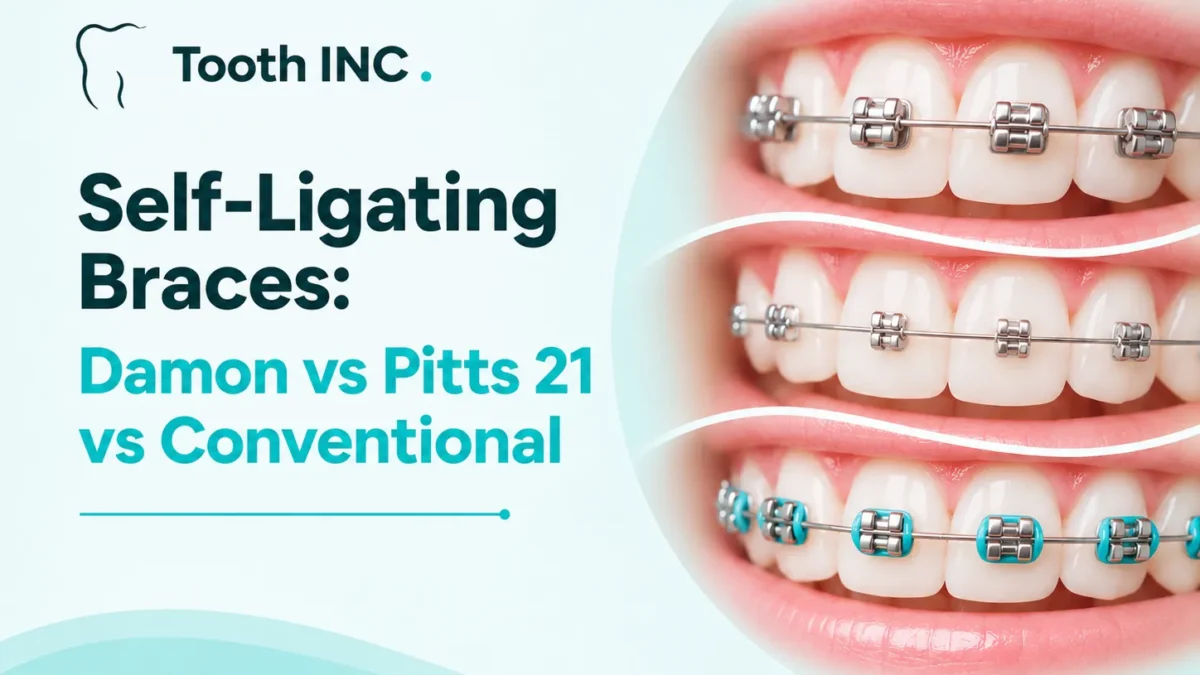
Self ligating braces straighten teeth using a built-in mechanical clip or sliding door instead of elastic bands to hold the archwire. This low-friction engineering reduces mechanical resistance, improves daily oral hygiene, and often lowers the frequency of orthodontic adjustment visits. Patients across Chandigarh now evaluate advanced bracket systems like Damon braces and Pitts 21 self ligating brackets alongside conventional metal appliances before beginning orthodontic care.
Choosing between these three orthodontic systems depends on your bite complexity, facial aesthetics, and daily routine. Whilst traditional brackets remain reliable for severe structural corrections, modern self ligating braces offer distinct biomechanical benefits for both teenagers and working adults. Understanding how each bracket interacts with the archwire helps you make a well-informed clinical decision with your orthodontist.
Clinical Mechanics of Self Ligating Braces
Self ligating braces use an integrated sliding gate or spring clip built directly into each bracket to secure the orthodontic archwire. By eliminating elastic ligatures, the wire slides freely through the bracket slot with minimal friction. This design allows teeth to move using lighter, biologically compatible forces.
In orthodontics, tooth movement occurs through controlled bone remodelling. When an archwire applies gentle pressure to a tooth, the surrounding periodontal ligament responds by reshaping the alveolar bone. Heavy forces can compress blood vessels in the gums, slowing down cellular activity and causing unnecessary soreness.
Self ligating braces operate in two primary ways: passive and active. Passive systems use a rigid sliding door that turns the bracket into a smooth tube, allowing the wire to glide without binding. Active systems use a flexible metal clip that presses lightly against thicker wires during the final stages of treatment to refine root angles. Both approaches remove the need for rubber ties, which degrade over time and trap food particles.
Damon Braces and Passive Sliding Technology
Damon braces pioneered passive self-ligation in modern orthodontics. The system pairs passive sliding-door brackets with shape-memory copper-nickel-titanium archwires. Because the door does not press tightly against the wire, teeth align along a path of least resistance.
During the initial months of treatment, Damon braces apply light, continuous forces that encourage gentle arch development. Clinical evidence suggests this low-friction environment may reduce the need for tooth extractions or palatal expanders in borderline crowding cases. The soft tissues of the cheeks, lips, and tongue work alongside the light wire forces to guide teeth into a balanced position.
Patients wearing Damon braces typically visit their orthodontist every eight to ten weeks rather than every four weeks. Because there are no elastic ties to lose elasticity, the archwire continues working steadily between appointments. This extended interval makes the system practical for students and working professionals across Chandigarh, Mohali, and Panchkula.
Aesthetic Options with Damon Self Ligating Ceramic Braces
Adults often hesitate to start orthodontic care because they want to avoid visible metal hardware. Damon self ligating ceramic braces address this concern by combining passive sliding mechanics with translucent polycrystalline alumina brackets. The ceramic body blends naturally with your enamel colour.
Unlike conventional clear braces that rely on transparent elastic ties, Damon self ligating ceramic braces have no rubber bands to absorb pigments from tea, coffee, or turmeric. The bracket stays clear throughout your treatment timeline. This stain resistance, paired with smooth rounded contours, makes Damon self ligating ceramic braces a popular choice for image-conscious professionals.
Precision Engineering in Pitts 21 Self Ligating Brackets
Pitts 21 self-ligating brackets represent a newer generation of passive self-ligating technology focused on three-dimensional control and facial aesthetics. Whilst standard brackets use a rectangular slot, Pitts 21 self ligating brackets feature a specialised 0.021-inch square slot design.
This square slot geometry engages the archwire much earlier in the treatment cycle. In many conventional and older self-ligating systems, orthodontists must wait several months for thicker wires to fill the bracket slot before they can control tooth rotation and root torque. Pitts 21 self ligating brackets establish torque control early, often allowing clinicians to complete alignment with fewer wire changes.
The compact, smooth-edged profile of Pitts 21 self ligating brackets also minimises irritation against the inner cheeks and lips. Because the system uses progressive light forces, patients generally experience minimal soreness following wire changes.
Smile Arc Protection and Facial Harmony
A defining feature of Pitts 21 self ligating brackets is the Smile Arc Protection (SAP) protocol. Traditional bracket placement often positions brackets in the exact centre of each tooth, which can sometimes flatten the natural curve of the upper front teeth.
With the Pitts 21 approach, the orthodontist positions brackets slightly closer to the gumline. This placement preserves and enhances the natural smile arc, ensuring the edges of your upper teeth follow the gentle upward curve of your lower lip when you smile. The system also broadens the dental arch, filling dark spaces at the corners of the mouth to create a fuller, balanced facial profile.
Conventional Braces and Elastomeric Ligation
Conventional braces have served as the clinical standard in orthodontics for decades. These appliances consist of high-grade stainless steel or ceramic brackets bonded to the enamel. The orthodontist threads an archwire through the bracket slots and secures it using tiny rubber rings called elastomeric ligatures, or fine stainless steel ties.
Elastic ligatures create friction between the bracket and the wire. To overcome this resistance, the orthodontist must apply slightly higher initial forces to initiate tooth movement. Because rubber ties stretch and lose tension within a few weeks, patients must attend adjustment visits every four to six weeks to have the ties replaced.
Despite the rise of self ligating braces, conventional appliances remain highly effective. They offer orthodontists direct, predictable mechanical control over severe bite discrepancies, complex rotations, and significant vertical jaw issues. Younger patients also enjoy the option to choose coloured elastic ties at each appointment.
Direct Comparison of Orthodontic Bracket Systems
Evaluating the structural and clinical differences between Damon braces, Pitts 21 self ligating brackets, and conventional appliances clarifies how each system performs in daily practice.
| Clinical Feature | Damon Braces | Pitts 21 Self Ligating Brackets | Conventional Braces |
|---|---|---|---|
| Ligation Mechanism | Passive sliding door (no ties) | Passive sliding door with square slot | Elastic rubber bands or metal ties |
| Friction Level | Very low; allows free wire sliding | Ultra-low with early 3D slot engagement | Moderate to high due to elastic ties |
| Torque Control Timing | Mid-to-late treatment phases | Early engagement from initial months | Progressive; depends on wire thickness |
| Appointment Intervals | Typically every 8 to 10 weeks | Typically every 8 to 10 weeks | Typically every 4 to 6 weeks |
| Aesthetic Availability | Metal and Damon self ligating ceramic braces | Metal and aesthetic translucent options | Metal and ceramic (clear ties may stain) |
| Plaque Accumulation | Low; no rubber bands to trap debris | Low; compact and smooth bracket design | Higher; elastic rings harbour food particles |
Clinical Advantages of Modern Self Ligating Braces
Patients transitioning from traditional orthodontics to self ligating braces notice practical improvements in comfort and daily convenience. Clinical observations highlight several core benefits:
- Shorter Chairside Appointments: Opening and closing a built-in sliding gate takes a fraction of the time required to remove and replace twenty-four individual elastic ties.
- Reduced Adjustment Discomfort: Lighter biological forces place less sudden pressure on the periodontal ligament, which may reduce post-adjustment soreness compared to tight elastomeric ties.
- Improved Plaque Control: Eliminating porous rubber rings removes a major trap for bacterial biofilm, helping keep your gums healthier during treatment.
- Fewer Clinic Visits: Longer intervals between adjustments reduce time away from school, university, or office schedules.
- Consistent Force Delivery: Metal clips and doors do not stretch or decay in saliva, maintaining steady wire engagement throughout the interval between visits.
Candidacy and Treatment Planning in Chandigarh
Selecting between self ligating braces and conventional systems is never a one-size-fits-all decision. Your orthodontist must evaluate your skeletal structure, periodontal health, and alignment goals before recommending a specific bracket.
Individuals with moderate to severe crowding, narrow dental arches, or busy travel schedules often benefit significantly from Damon braces or Pitts 21 self ligating brackets. Adults seeking discreet fixed appliances frequently favour Damon self ligating ceramic braces because they resist staining from Indian dietary spices and beverages.
However, the bracket itself is only a tool. The ultimate outcome of any orthodontic treatment depends heavily on the diagnostic skill and treatment planning of the specialist. Accurate 3D digital scanning, cephalometric X-ray analysis, and careful archwire sequencing determine how well your teeth align and how stable your bite remains after debonding.
Factors that influence the overall investment for self ligating braces include the brand of the bracket system, whether you choose metal or ceramic materials, the severity of your malocclusion, and the total duration of active care. A transparent diagnostic consultation outlines these variables clearly before treatment begins.
Daily Oral Hygiene and Appliance Maintenance
Even though self ligating braces are easier to clean than conventional brackets, fixed appliances still require disciplined daily hygiene. Food particles and plaque can accumulate around the bracket base and under the archwire, leading to white spot lesions or gum inflammation if neglected.
- Brush After Every Meal: Use a soft-bristled orthodontic toothbrush angled at 45 degrees towards the gumline to clear debris around the sliding doors.
- Use Interdental Brushes: Small proxy brushes slide easily beneath the archwire to clean the sides of each bracket where standard bristles cannot reach.
- Incorporate a Water Flosser: A pressurised stream of water flushes out trapped food particles along the gum margin and between tight teeth efficiently.
- Protect the Sliding Mechanism: Avoid biting directly into hard nuts, ice cubes, or sticky sweets, which can bend the archwire or damage the bracket gate.
- Schedule Regular Cleanings: Professional scaling every six months removes hardened tartar and keeps your gums healthy throughout your orthodontic journey.
Specialist Orthodontic Care at ToothInc Chandigarh
Achieving a balanced bite and a natural smile arc requires specialist-led planning. At ToothInc, located in Sector 18-D, Chandigarh, orthodontic care is headed by Dr. Karan Seth (MDS Orthodontics & Dentofacial Orthopaedics). The clinic offers a full range of modern bracket systems, including Damon braces, Damon self ligating ceramic braces, and Pitts 21 self ligating brackets.
ToothInc uses 3D and 5D digital dental scans to map your tooth movements accurately, eliminating the discomfort of traditional impression pastes. Every treatment plan is tailored to your facial proportions and long-term oral health. The clinic also maintains a calm, anxiety-free atmosphere with strict medical-grade sterilisation, making every adjustment visit comfortable and predictable.
Conclusion
Modern orthodontics offers reliable solutions for every alignment challenge. Self ligating braces have refined fixed-appliance therapy by removing elastic ties, lowering friction, and simplifying daily oral hygiene. Damon braces provide proven passive sliding mechanics and stain-resistant Damon self ligating ceramic braces for discreet care, whilst Pitts 21 self ligating brackets deliver early torque control and focused smile arc aesthetics. Conventional braces remain a dependable, versatile option for comprehensive bite correction. Consulting a qualified MDS orthodontist ensures you select the system that aligns with your dental anatomy and lifestyle.
Book Your Orthodontic Assessment at ToothInc
Choosing the right bracket system starts with an accurate digital diagnosis. At ToothInc in Sector 18-D, Chandigarh, Dr. Karan Seth and the specialist team evaluate your jaw alignment, facial balance, and oral health using high-definition 3D scanning.
Schedule your orthodontic consultation at ToothInc today to compare self ligating braces, Damon braces, and Pitts 21 self ligating brackets in person. Take the first step towards a healthy, well-aligned smile in a relaxed, modern clinical setting.
Frequently Asked Questions:
Are self ligating braces faster than conventional braces?
Self ligating braces may shorten overall treatment time in certain cases by reducing wire friction and allowing continuous tooth movement. However, total duration still depends on bone density, age, and the severity of your misalignment.
Do Damon braces hurt less than traditional metal braces?
Evidence suggests that Damon braces often cause less post-adjustment soreness than conventional braces. Because they use light biological forces without tight rubber ties, there is lower initial pressure on the teeth and gums.
What makes Pitts 21 self ligating brackets different from Damon braces?
Pitts 21 self ligating brackets use a specialised square slot that engages the archwire earlier for three-dimensional torque control. They also follow a Smile Arc Protection protocol designed to enhance upper tooth display and facial harmony.
Do Damon self ligating ceramic braces turn yellow over time?
No, Damon self ligating ceramic braces are crafted from stain-resistant polycrystalline alumina. Because they do not use clear elastic ties, they will not discolour from tea, coffee, or everyday spices between your clinic visits.
Can self ligating braces treat severe crowding without extractions?
In many borderline cases, self ligating braces gently expand the dental arch to create space, reducing the need for extractions. Severe skeletal crowding or protruding teeth may still require extractions for a stable, healthy bite.
How often do I need to visit the clinic with self ligating braces?
Patients wearing self ligating braces typically attend adjustment appointments every eight to ten weeks. This is less frequent than conventional braces, which usually require visits every four to six weeks to replace worn elastic ties.