Beginning orthodontic treatment is a significant step toward lasting oral health, facial balance, and personal poise. When considering treatment, patients frequently ask: how long do braces take to deliver a straight smile? The journey varies from person to person because tooth alignment is a biological remodeling process rather than a mechanical race.
On average, active orthodontic treatment spans between 12 and 24 months. Some minor alignment adjustments finish in as few as 6 to 9 months, whereas intricate bite corrections may take up to 30 months. In modern orthodontics, specialists tailor every phase to the patient’s underlying anatomy.
At ToothInc in Sector 18, Chandigarh, Dr. Karan Seth (MDS Orthodontics) uses high-definition digital scans to map each phase with precision, ensuring that every stage of tooth movement remains efficient, gentle, and predictable.
Factors Determining How Long Do Braces Take
Tooth movement depends on bone remodeling. When orthodontic brackets and archwires exert calibrated pressure, bone resorbs on the compressed side of the tooth root while new bone forms on the tension side. Because human bone tissue remodels at an average rate of approximately one millimeter per month, biological pace dictates your overall braces duration.
Several clinical variables influence your timeline:
- Degree of Malocclusion: Simple cosmetic spacing closes rapidly, whereas rotated roots, skeletal overjets, underbites, or impacted canine teeth require gradual guidance to seat properly.
- Patient Age and Metabolic Response: Teenagers benefit from higher cellular turnover and active jaw development. Adults have mature, denser alveolar bone, requiring steady force vectors to remodel bone safely without compromising root integrity.
- Patient Compliance: Wearing intermaxillary elastics as directed, attending regular tightening visits, and avoiding hard foods that pop brackets off enamel keep your alignment progressing smoothly.
- Appliance Selection: Friction-free brackets like Pitts 21 or customized clear aligners like Invisalign allow teeth to move along calibrated paths, reducing chairside adjustment delays.
Braces Treatment Time for Mild Alignment Cases
Mild orthodontic cases focus on anterior aesthetic alignment and small space closures where the posterior bite relationship remains completely healthy. Common examples include minor front-tooth crowding, modest rotations, or small midline gaps measuring less than two millimeters.
In these straightforward scenarios, the braces treatment time typically ranges from 6 to 12 months. Because the molars and premolars already fit together comfortably, the orthodontist does not need to move entire quadrants of teeth forward or backward.
For young adults and professionals throughout Chandigarh who want discreet correction for minor alignment issues, aesthetic systems like ceramic brackets, Damon Clear, or clear aligners achieve predictable results without prolonged treatment plans.
Moderate Misalignments and the Standard Orthodontic Window
The vast majority of orthodontic patients present with moderate dental discrepancies. This category includes noticeable anterior crowding, pronounced gaps, mild crossbites, and Class II or Class III bite issues that alter tooth engagement.
For moderate cases, the average braces duration ranges between 12 and 20 months. During this period, treatment accomplishes two distinct goals: leveling the dental arches and correcting how upper and lower teeth interlock during chewing.
Orthodontists employ specialized stainless steel or beta-titanium archwires alongside intermaxillary rubber elastics to shift the dental arches into functional harmony. Because both crown positioning and root angulation are refined, moderate cases require this extended window to ensure long-term stability and prevent relapse.
Complex Orthodontic Corrections and Structural Adjustments
Complex malocclusions involve profound skeletal or anatomical discrepancies that demand intricate biomechanical planning. These cases include severe crowding requiring premolar extractions, deeply impacted canine teeth stuck inside the palate, severe open bites, and pronounced skeletal jaw misalignments.
In complex scenarios, the timeline extends from 20 to 30 months, and occasionally longer if coordinated with orthognathic jaw surgery. The initial months focus on creating room and guiding impacted teeth into the arch. Subsequent phases address bodily root translation through dense cortical bone, followed by intercuspation to seat the bite.
While extended timelines require patience, completing this structural care prevents premature tooth wear, alleviates temporomandibular joint (TMJ) strain, and restores healthy facial balance.
Orthodontic Timeline Matrix by Case Severity
| Case Classification | Typical Clinical Conditions | Average Braces Duration | Primary Treatment Focus |
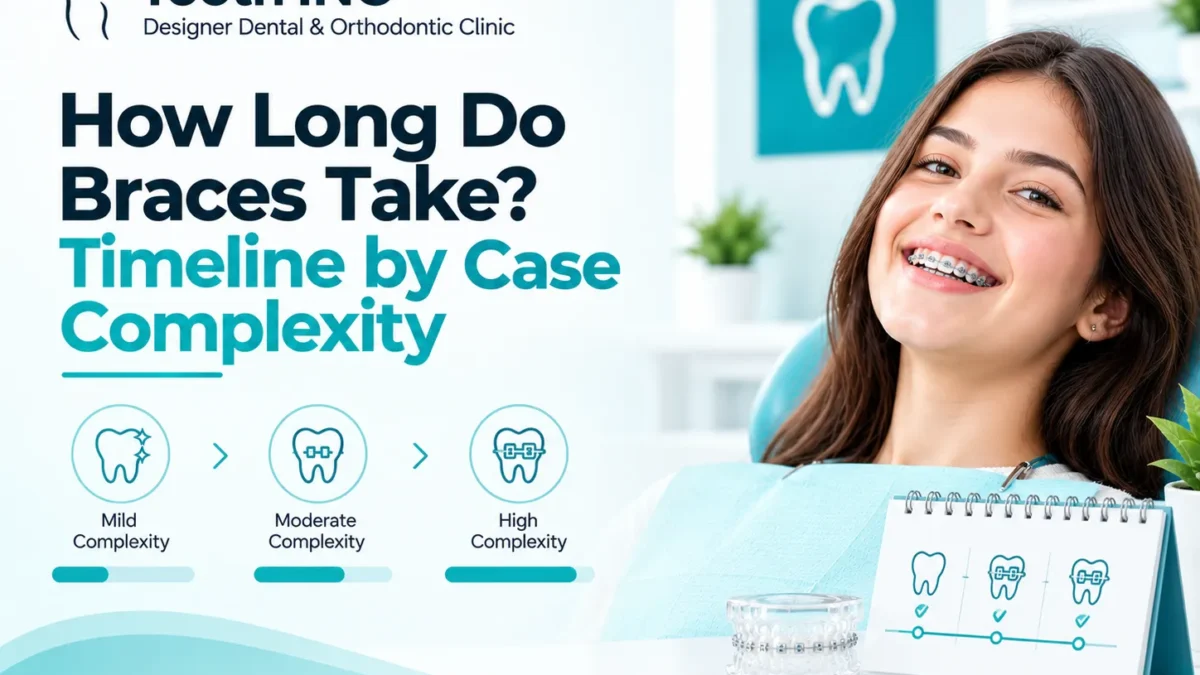
| Mild Complexity | Minor crowding (<3mm), slight gaps, small rotations, stable bite | 6 to 12 Months | Anterior aesthetic alignment and arch leveling |
| Moderate Complexity | Moderate crowding, deep overbite, mild crossbite, small extraction gaps | 12 to 20 Months | Arch coordination, bite alignment, and space closure |
| Severe Complexity | Severe crowding, impacted canines, skeletal discrepancies, open bites | 20 to 30+ Months | Bodily root movement, jaw alignment, and full bite rebuilding |
The Three Active Phases of Orthodontic Care
Orthodontic movement follows an orderly progression of physiological stages:
Leveling and Alignment
The opening stage spans the first three to eight months of treatment. Flexible nickel-titanium (NiTi) shape-memory archwires gently pull crooked teeth into an even horizontal plane and undo visible rotations. Patients often notice striking visual improvements during this initial phase, which boosts their motivation early on.
Bite Correction and Space Closure
Once the dental arches are level, the orthodontist transitions to stiffer rectangular stainless steel archwires. Over months eight through twenty, the focus shifts to closing extraction gaps, correcting overbites, and aligning premolars and molars. Intermaxillary elastics are worn continuously during this stage to guide the upper and lower jaws into harmony.
Detailing and Finishing
The final three to six months focus on micro-adjustments. The orthodontist places gentle artistic bends in the wire to perfect root angulation, crown torque, and marginal ridge heights. Once teeth articulate in an optimal bite, the appliances are carefully debonded.
Protecting Your Progress During the Retention Phase
The active period ends the day your brackets come off, but orthodontic care continues into retention. Newly repositioned teeth are surrounded by pliable elastic periodontal fibers and immature alveolar bone that require time to reorganize. Without retainers, teeth naturally drift back toward their original positions.
Patients wear custom-milled transparent retainers full-time for the first several months, removing them only for eating and brushing. Afterward, wear transitions to nights only. Fixed lingual retainer wires bonded behind the front teeth provide reliable insurance against unwanted relapse, safeguarding your aligned smile for decades.
Daily Habits That Prevent Unwanted Treatment Delays
Your daily choices play an active role in whether your treatment finishes on schedule. Simple habits keep your timeline moving forward:
- Wear Your Elastics Consistently: Intermaxillary elastics provide the continuous force needed to shift your bite. Forgetting them interrupts movement and prolongs your treatment timeline.
- Keep Up with Scheduled Adjustments: Every adjustment builds on the previous one. Missing your regular four-to-six-week clinic appointments stalls progress.
- Protect Your Brackets: Chewing on ice, hard candies, or sticky sweets can dislodge brackets. Each broken bracket halts active movement on that tooth until repaired.
- Maintain Meticulous Plaque Hygiene: Swollen gums slow down safe bone remodeling and require clinical pauses. Use interdental brushes and water flossers to keep brackets clean.
Specialist Orthodontic Care at ToothInc Chandigarh
Navigating an orthodontic journey is far more comfortable when supported by specialized clinical planning. Located in Sector 18, Chandigarh, ToothInc provides focused orthodontic care led by Dr. Karan Seth (MDS Orthodontics & Dentofacial Orthopaedics). Rather than applying generic treatment templates, ToothInc relies on 3D digital diagnosis to formulate an accurate, individualized timeline for every patient.
ToothInc combines clinical precision with a calm, boutique clinic setting designed to eliminate anxiety. With peaceful interiors, low-radiation imaging, and dedicated progress monitoring, your visits remain relaxed from initial scanning through your final debonding appointment.
Book Your Orthodontic Assessment at ToothInc Chandigarh
Understanding your treatment timeline gives you clear expectations and confidence as you begin your smile transformation. A comprehensive clinical evaluation reveals your bone structure, dental alignment, and exact case complexity, giving you an accurate picture of what your journey will look like.
Schedule your consultation with Dr. Karan Seth at ToothInc in Sector 18, Chandigarh. Take advantage of advanced digital smile mapping to start your journey toward a balanced, healthy smile.
Conclusion
Undergoing orthodontic care is an investment in both your oral health and long-term confidence. While treatment timelines vary from quick six-month alignments to comprehensive two-year bite corrections, understanding your case complexity helps set realistic expectations.
Modern diagnostic imaging and low-friction bracket engineering make the alignment process smoother, more predictable, and easier to integrate into daily life. With regular clinic check-ups, disciplined oral hygiene, and consistent wear of your appliances, you can ensure your treatment finishes on schedule.
Frequently Asked Questions
1. What is the shortest time braces take to straighten teeth?
Mild cosmetic misalignments can resolve in 6 to 9 months using targeted alignment systems. However, correcting complete bite relationships safely requires 12 to 18 months of continuous physiological remodeling.
2. Can adults achieve fast results with modern braces?
Adult bone is fully mature and remodels at a controlled biological pace, but advanced self-ligating brackets and clear aligners allow adults to complete moderate treatment within the standard 18 to 24 month window comfortably.
3. How do broken brackets affect overall braces duration?
A broken bracket disconnects that tooth from the archwire, halting active movement immediately. Frequent bracket breakages can easily extend your total orthodontic timeline by several months.
4. Are self-ligating brackets faster than traditional braces?
Self-ligating brackets use slide mechanisms that reduce friction along the wire. While biological bone remodeling speeds remain similar, reduced friction often lowers chairside adjustment time and keeps movement steady.
5. Does wearing elastics really speed up orthodontic treatment?
Elastics do not rush biology, but wearing them as directed maintains continuous force vectors. Inconsistent wear lets teeth slip back, adding weeks or months of corrective work to your schedule.