

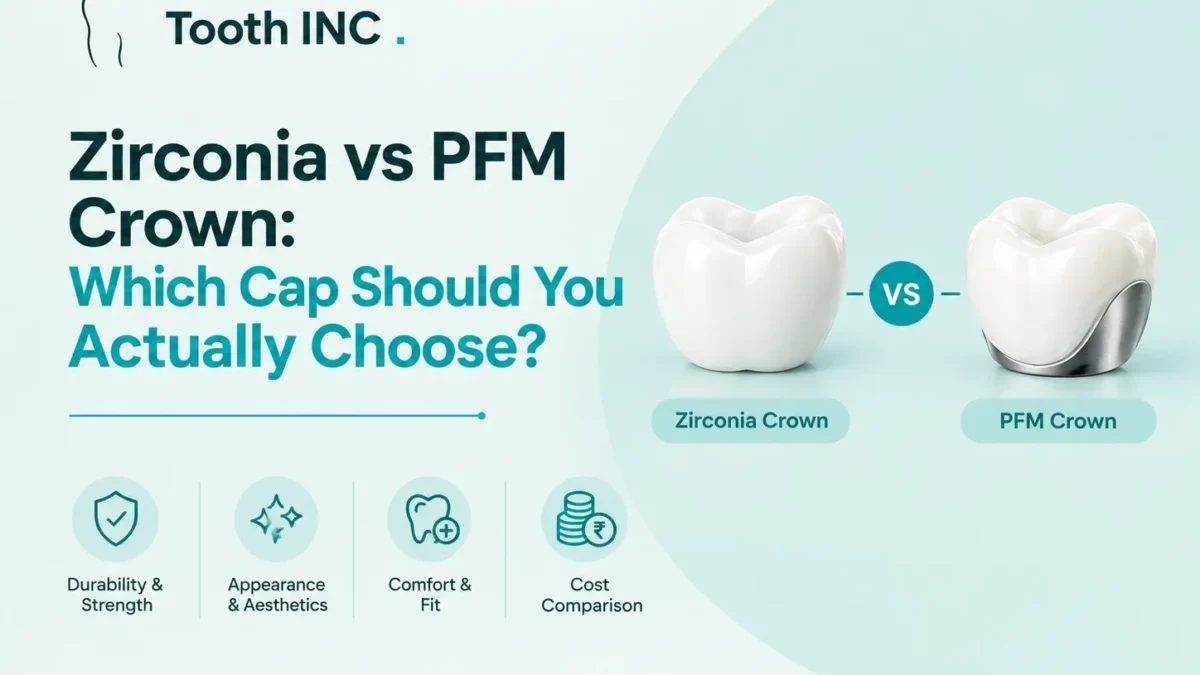
Restoring a heavily treated or damaged tooth requires choosing the right protective cap. When deciding between a Zirconia vs PFM crown, patients often balance visual appeal against functional bite strength and long-term durability. A well-fitted dental restoration preserves remaining tooth structure, prevents fractures after root canal therapy, and restores full chewing efficiency. Selecting between a modern Zirconia vs PFM crown depends on the position of the tooth, your bite forces, and aesthetic goals.
Modern prosthodontics offers high-performance materials ranging from traditional metal ceramic crown options to advanced zirconium cap designs. At Toothinc in Chandigarh, restorative procedures are planned with digital precision and clinical craftsmanship to ensure natural aesthetics and lasting oral health.
Zirconia vs PFM Crown: Material Composition and Structural Differences
Dental crowns act as custom-fitted caps that encase a prepared natural tooth or implant abutment. The fundamental distinction between these two restorations lies in their material architecture and manufacturing processes.
- PFM Crown Architecture: A traditional PFM crown features a cast or laser-sintered metal alloy substructure coated with a baked dental porcelain layer. This hybrid design provides reliable internal support while masking the underlying metal with a tooth-coloured facade.
- Zirconia Crown Architecture: A modern zirconium cap is milled from a solid block of monolithic zirconium dioxide ceramic using precision computer-aided design. Because it is entirely metal-free, it eliminates internal grey margins and offers uniform structural density.
Evaluating a Zirconia vs PFM crown helps you understand how these distinct compositions perform under daily chewing demands.
Aesthetic Performance and Natural Smile Integration
Visual discretion is a crucial deciding factor, especially when restoring visible front teeth in the aesthetic zone.
- Light Translucency: Natural tooth enamel is semi-translucent, reflecting light across its crystalline structure. Monolithic and multi-layered zirconia mimics this optical depth closely, blending invisibly with adjacent natural enamel.
- The Dark Margin Risk: A conventional metal ceramic crown relies on a metal collar near the gum line. Over time, natural gum recession can expose a distinct grey line, creating an artificial appearance.
- Colour Stability: Both materials offer excellent shade retention, but an all-ceramic zirconium cap maintains consistent optical brightness under diverse lighting conditions without showing internal metal opacity.
Structural Strength, Bite Resistance, and Durability
Both restorative options deliver dependable clinical strength, yet they handle daily chewing forces differently over decades of use. While the internal alloy framework of a PFM crown provides solid structural resilience, its outer cosmetic porcelain veneer remains vulnerable to chipping under heavy bite loads. In contrast, a solid zirconium cap is milled from uniform monolithic ceramic, offering exceptional fracture resistance that easily withstands intense posterior pressure.
Material thickness also directly influences tooth preservation and long-term oral balance. Placing a traditional metal ceramic crown requires significant enamel reduction to fit both the metallic substructure and porcelain facade. Zirconia achieves superior flexural strength even at minimal thicknesses, allowing for conservative tooth preparation while providing a smooth, polished surface that protects opposing natural teeth from abrasive wear.
Biocompatibility and Soft Tissue Health
Healthy gum margins are essential for the longevity of any dental restoration.
- Gum Margin Friendliness: Zirconia is bio-inert and exceptionally smooth, preventing bacterial plaque accumulation and encouraging healthy soft tissue attachment.
- Metal Sensitivity: Standard metal ceramic crown restorations incorporate nickel, cobalt, or chromium alloys, which may occasionally trigger localized tissue sensitivity or dark gum pigmentation in reactive patients.
- Thermal Insulation: All-ceramic caps act as natural insulators, minimizing post-placement temperature sensitivity to hot or cold foods.
Direct Comparison of Restoration Features
| Evaluation Criteria | Zirconia Crown Restoration | PFM (Porcelain-Fused-to-Metal) Crown |
| Material Build | 100% monolithic zirconium dioxide ceramic | Cast or sintered metal alloy core with porcelain coating |
| Aesthetic Value | High translucency; matches natural enamel without grey lines | Good shade match, but metal margin may show over time |
| Chipping Risk | Minimal; uniform single-block structural density | Moderate; outer cosmetic porcelain layer can chip |
| Enamel Reduction | Conservative tooth trimming required | Requires greater tooth reduction for dual layers |
| Biocompatibility | 100% metal-free, hypoallergenic, and gentle on gums | Metal substructure may cause mild tissue sensitivity |
| Ideal Clinical Placement | Front smile zone and heavy-load posterior molars | Posterior molars and standard bridge restorations |
Practical Selection Guide for Your Dental Needs
Choosing between a Zirconia vs PFM crown depends on your oral anatomy, aesthetic expectations, and budget considerations.
A Zirconium Cap Is Ideal For:
- Restoring anterior front teeth where lifelike translucency and natural contours are vital.
- Patients who clench or grind their teeth (bruxism) and require superior fracture resistance.
- Individuals with diagnosed metal sensitivities or those who prefer metal-free biocompatibility.
A Metal Ceramic Crown Is Ideal For:
- Patients seeking a time-tested, budget-friendly cap for rear molars.
- Multi-unit posterior dental bridges requiring rigid internal metallic frameworks.
- Situations where functional bite restoration is prioritized over smile line aesthetics.
Restore Your Smile with Precision Care at Toothinc Chandigarh
Your teeth deserve restorative care that combines high clinical accuracy with personalized aesthetic planning. Located in Chandigarh, Toothinc provides an anxiety-free, boutique dental setting led by experienced dental specialists. Whether you need a CAD/CAM-milled zirconium cap, a precision-engineered PFM crown, or complete full-mouth rehabilitation, our team uses digital diagnostics to deliver restorations that look natural and last for years.
Book your consultation at Toothinc Chandigarh today and protect your natural smile with specialist care.
Conclusion
Choosing the ideal dental restoration comes down to aligning tooth location, bite force, and personal aesthetic goals. A traditional metal ceramic crown continues to serve as a reliable, cost-effective option for rear molars where functional chewing strength matters most. However, when restoring front teeth or seeking maximum longevity without grey gum lines, a zirconium cap provides superior lifelike translucency, conservative tooth trimming, and bio-inert gum compatibility.
Both options offer dependable protection when planned with clinical precision. A detailed evaluation with the restorative team at Toothinc in Sector 18, Chandigarh, ensures your final Zirconia vs PFM crown selection is custom-designed to match your natural smile line and deliver lasting bite comfort.
Frequently Asked Questions
1. How does a Zirconia vs PFM crown differ in overall durability?
Zirconia is milled from solid monolithic ceramic and resists chipping, whereas the outer porcelain layer of a PFM crown can chip over time under heavy pressure.
2. Will a metal ceramic crown show a dark line near the gums?
Yes, as natural gums recede over years of use, the underlying dark metal collar of a PFM cap may become visible along the gum line.
3. Is a zirconium cap suitable for back molar teeth?
Yes, zirconia offers exceptional flexural strength, making it ideal for withstanding high chewing forces on posterior molars without fracturing.
4. Does placing a PFM crown require more tooth cutting?
Yes, PFM restorations require greater tooth reduction to accommodate both the metal alloy base and the outer porcelain aesthetic layer.
5. Are zirconia caps completely biocompatible and safe for gums?
Yes, zirconia is 100% metal-free and bio-inert, which prevents gum irritation, eliminates allergic reactions, and promotes optimal soft tissue health.